


IBM Quantum
We deliver IBM Quantum to the enterprise.
We take the combinatorial decisions of telecom, retail, the public sector, finance, manufacturing and defense and write them in a form a quantum computer can solve. We write them in Qiskit, check every answer against the classical optimum, say on each result what produced it, and wire it back into operations through VENETA WorldModel. Telecom and retail instances have run on IBM quantum systems.
Partnership
IBM Quantum GSI (Global Systems Integrator) agreement signed.
VENETA Korea Inc., which contracts IBM Quantum delivery for VENETA, signed the IBM Quantum GSI (Global Systems Integrator) agreement on 30 September 2026. Our quantum path is IBM and nothing else: Qiskit, the Aer simulator, IBM quantum systems and the IBM roadmap.
For a customer that means this. The team that builds and runs the algorithms works inside the IBM Quantum ecosystem, on IBM systems, with IBM's tooling, and every result comes back with enough about its conditions for your own experts to check it.
What we deliver
From the problem to production.
Algorithm development
We take the combinatorial part of an operations question and write it as an optimization problem, with a known classical optimum to compare the answer against.
Simulation
We run QAOA on Qiskit with the Aer simulator, inside your network. Most questions are answered here.
Hardware runs
We run on IBM quantum systems with the noise in mind. We try several layouts and keep the one with the highest estimated fidelity, leave error suppression on, and cache the results so they can be reproduced.
Verification and integration
We report how far the answer landed from the classical optimum, where it ranks among the feasible plans, how much better it is than a random plan, and what the calibration data says about the run. Then we wire it into WorldModel.
Industries
Where the algorithms run.
Telecom
We solve site and channel assignment, crew dispatch, nighttime cell sleep and backhaul rerouting.
Public sector
We solve allocation and scheduling problems for public infrastructure, inside closed networks.
Finance
We solve portfolio and hedging composition, and the batching of settlements.
Manufacturing
We solve process and equipment scheduling, material routing and the allocation of inspection resources.
Defense
We solve allocation and scheduling inside closed networks. Anything sent to the hardware goes only when the egress policy allows it.
Your problem class
Bring us the question. We put it in a solvable form and tell you whether quantum earns its place.
Telecom and retail have run on IBM quantum systems. The others are problem classes we work out together with you.
What a result carries
Every number has its label.
- Backend
- Whether a simulator ran it, and if an IBM system did, which one.
- Qubits · shots · depth
- How many qubits and shots it used, and how deep the circuit was.
- Gap
- How far the answer landed from the known classical optimum.
- Rank and lift
- Where the chosen plan ranks among all the feasible ones, and how much better it is than a random plan.
- Verdict
- Whether the system's calibration data for that day makes the instance QPU-ready, marginal, or too deep to run.
- Larger instances
- We split them into pieces that fit the hardware. The loop that puts the pieces back together is classical, and we say so.
IBM Quantum roadmap
We build on the roadmap, not ahead of it.
IBM publishes a development roadmap and updates it every year. Its 2025 update puts Nighthawk processors at 120 qubits and 7,500 gates in 2026, growing to 15,000 gates by 2028 with up to nine processors linked; Starling, IBM's first large-scale, fault-tolerant quantum computer, with 200 logical qubits and 100 million gates, in 2029; and Blue Jay, with 2,000 logical qubits and one billion gates, after 2033. IBM's roadmap places the first examples of quantum advantage in 2026.
Our delivery follows that line. The instances we run today fit the utility-scale Heron and Nighthawk systems, our depth budget tells you whether an instance is ready for the hardware, and the parts of a question that need fault tolerance stay on the simulator until the hardware arrives. Every roadmap figure above is IBM's statement, not ours.
IBM's roadmap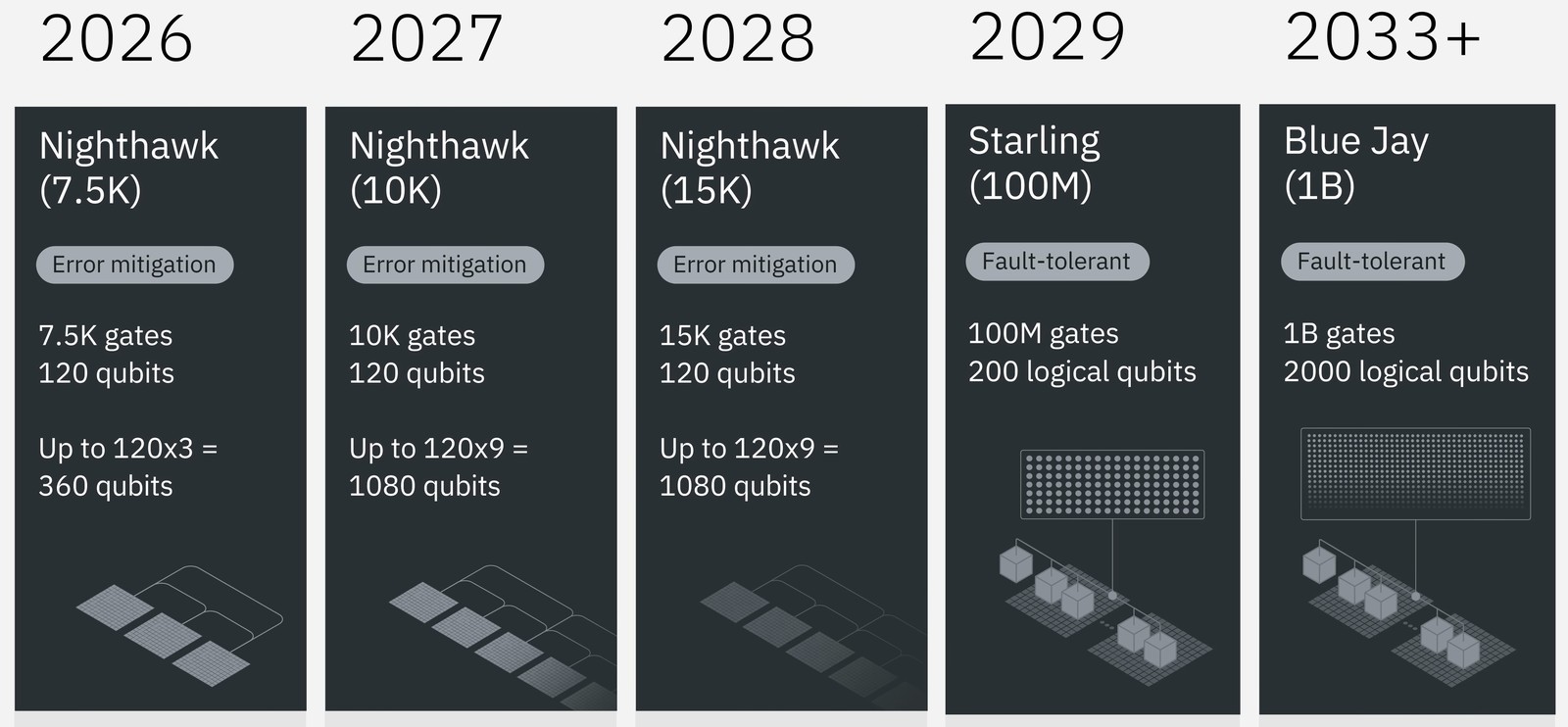
Egress
Nothing leaves without a record.
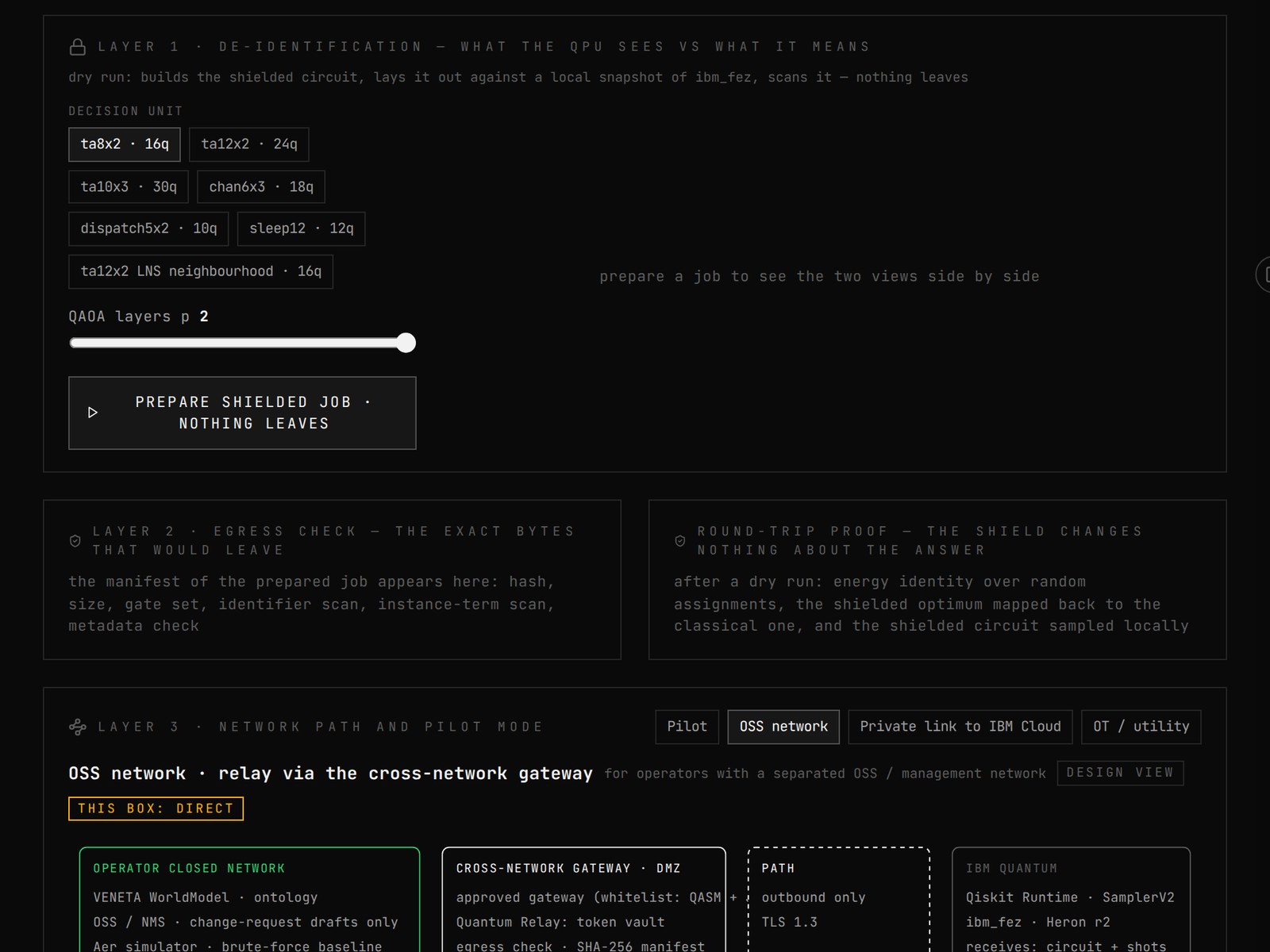
Every submission goes through the egress gate. The payload is scanned and hashed, and one line goes into an append-only egress ledger naming the shield that was applied. Which shield applies depends on the job, and the ledger records the one that was used. The shield does not hide the shape of the graph, and we say so rather than imply otherwise.
Talk to us about your operating data.
Tell us which system holds the question you cannot ask today. A person answers every message.